NSE6_FMG_AD-7.6 Exam: Understanding FortiManager 7.6 Administration And Management
Modern security teams often manage large numbers of FortiGate devices across distributed networks. Managing every firewall individually can become difficult as the environment grows. FortiManager addresses this challenge by providing centralized management for Fortinet security environments.
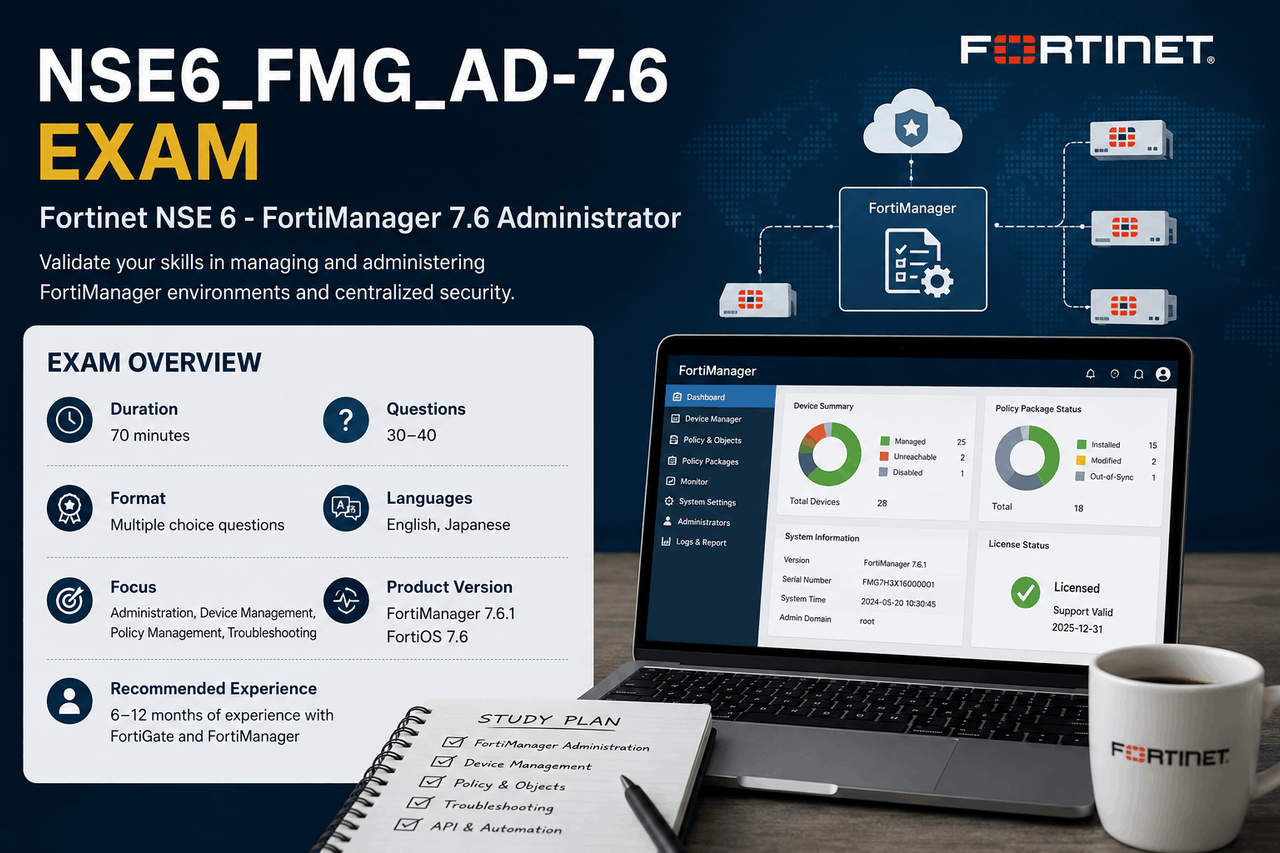
The NSE6_FMG_AD-7.6 exam, officially named Fortinet NSE 6 - FortiManager 7.6 Administrator, evaluates practical knowledge of FortiManager configuration, operation, centralized device management, policy administration, and troubleshooting.
According to the Fortinet Training Institute, the exam is intended for network and security analysts responsible for centrally administering multiple FortiGate devices through FortiManager. The current exam is based on FortiManager 7.6.1 and FortiOS 7.6.
For candidates preparing for the certification, understanding what FortiManager does and how its administrative functions work is more useful than relying solely on memorization.
What Is The NSE6_FMG_AD-7.6 Exam?
The NSE6_FMG_AD-7.6 exam tests applied knowledge of FortiManager. Fortinet describes the assessment as covering operational scenarios, system configuration, device registration, and troubleshooting.
The exam is aimed at professionals who already have practical exposure to FortiGate and FortiManager environments. Fortinet recommends between six months and one year of hands-on experience with these technologies.
This experience recommendation is important because many FortiManager tasks are easier to understand when candidates have worked with centralized policy management, device registration, administrative domains, and deployment workflows in an actual environment.
NSE6_FMG_AD-7.6 Exam Details
The current Fortinet Training Institute information lists the following details:
✔ Exam: Fortinet NSE 6 - FortiManager 7.6 Administrator
✔ Exam code: NSE6_FMG_AD-7.6
✔ Duration: 70 minutes
✔ Number of questions: 30-40
✔ Scoring: Pass or fail
✔ Languages: English and Japanese
✔ Product version: FortiManager 7.6.1 and FortiOS 7.6
Because Fortinet certification information can change, candidates should verify the official exam page before scheduling the assessment.
Core Areas Covered By The Exam
The FortiManager 7.6 Administrator exam focuses on several practical areas of centralized administration. The objectives include administration, device management, policy and object management, configuration tasks, and troubleshooting.
FortiManager Administration
A solid understanding of FortiManager administration is the foundation of the exam.
Candidates should understand the major features of FortiManager and how it fits into a Fortinet Security Fabric environment. Administrative domains, commonly called ADOMs, are particularly important because they help organize and manage devices and configurations within FortiManager.
The administration objectives also include initial configuration and understanding the FortiManager interface and architecture.
Fortinet's official training information specifically recommends understanding FortiManager features, ADOMs, the relationship between FortiManager and FortiAnalyzer, network topology, and the FortiManager API.
Initial Configuration
Initial configuration is another practical area candidates should understand.
This includes factory-default settings, the setup wizard, basic system configuration, and requirements that should be considered before deploying FortiManager.
Candidates should approach this topic from an implementation perspective. Instead of memorizing individual configuration screens, consider what information an administrator needs before introducing FortiManager into an existing network.
For example, network design, device organization, administrative requirements, and integration with other Fortinet products can influence the configuration approach.
Device Registration And Centralized Management
One of FortiManager's main purposes is centralized management of FortiGate devices.
Candidates should understand how devices are added and managed through FortiManager and how FortiManager communicates with managed devices.
Device registration becomes especially important in environments containing many FortiGate systems. A centralized platform allows administrators to maintain configurations and policies more consistently than managing every device separately.
Understanding the relationship between FortiManager and managed FortiGate devices can also help with troubleshooting questions.
Policy And Object Management
Centralized policy management is a major reason organizations deploy FortiManager.
Candidates should understand how policies and configuration objects are organized and managed. This includes concepts surrounding policy packages, shared objects, device-specific configuration, and policy deployment.
A useful way to study this area is to think about the lifecycle of a configuration change:
✔ Identify the required change.
✔ Modify the relevant object or policy.
✔ Review the configuration.
✔ Determine the appropriate target device or devices.
✔Install or deploy the change.
✔ Verify the result.
Understanding this workflow provides a stronger foundation for scenario-based questions.
Administrative Domains And Device Organization
Administrative domains, or ADOMs, allow administrators to organize FortiManager resources and devices according to an organization's management requirements.
ADOMs can be particularly useful in environments where different groups, customers, or FortiOS versions need to be managed separately.
Candidates should understand why an administrator would use an ADOM and how it affects the management structure.
This is especially relevant in larger environments where centralized administration needs to remain organized and controlled.
FortiManager And FortiAnalyzer Integration
The exam also includes concepts related to the relationship between FortiManager and FortiAnalyzer.
Although the products serve different primary purposes, they can work together within a Fortinet environment. Understanding their roles helps administrators determine which platform is responsible for particular management, logging, analytics, or operational tasks.
Fortinet's exam objectives specifically include FortiManager's ability to manage FortiAnalyzer and its integration with FortiAnalyzer features.
FortiManager API
Automation is increasingly important in network administration, and the FortiManager exam includes API-related knowledge.
Candidates should understand supported API methods, HTTP response codes, and common API use cases.
The official objectives mention examples such as login and logout requests and retrieving firewall package installation targets.
You do not necessarily need to become a software developer to understand this area. The important concept is recognizing how APIs can allow administrators and automation tools to interact programmatically with FortiManager.
Troubleshooting FortiManager
Troubleshooting is an important practical skill for FortiManager administrators.
A centralized management platform can involve several components, including FortiManager itself, managed FortiGate devices, policies, configurations, connectivity, and administrative permissions.
When troubleshooting, administrators should first identify where the problem occurs. For example, a configuration problem may be different from a device-registration issue or a policy-installation problem.
Hands-on laboratory practice can be particularly valuable here because it allows candidates to observe how configuration changes affect managed devices.
How To Prepare For NSE6_FMG_AD-7.6
The best preparation approach combines official Fortinet training material with practical experience.
Fortinet recommends the FortiManager 7.6 Administrator course and hands-on labs, along with the FortiManager 7.6 Administration Guide, New Features Guide, and CLI Reference.
Begin by learning the FortiManager interface and basic administration. Then move into ADOMs, device registration, policy management, configuration deployment, and troubleshooting.
Hands-on practice should be a major part of the preparation process. Try to reproduce common administrative tasks in a controlled lab environment and observe the results.
It is also useful to study the FortiManager documentation alongside the lab work. Fortinet's official documentation provides administration guides, CLI references, release information, and other resources for the 7.6 product line.
Using NSE6_FMG_AD-7.6 Practice Questions
Practice questions can help candidates evaluate their understanding after studying the official objectives.
The best way to use them is as a self-assessment tool. When an answer is incorrect, review the underlying FortiManager concept instead of simply memorizing the correct option.
Fortinet itself provides sample questions through its training resources and explains that these samples represent the exam's question type and content scope but do not cover every possible exam topic or guarantee readiness.
NSE6_FMG_AD-7.6 Exam Question Resource:
https://www.dumpslink.com/NSE6_FMG_AD-7.6-pdf-dumps.html
This is a natural location for one relevant practice-question resource while keeping the article primarily educational rather than promotional.
Common Preparation Mistakes
One common mistake is studying FortiManager only from theoretical documentation without using a lab environment. Because the exam evaluates applied knowledge, practical experience can make many concepts easier to understand.
Another mistake is focusing only on the graphical interface. Administrators should also understand relevant CLI and API concepts included in the exam objectives.
Candidates should also avoid confusing FortiManager with FortiAnalyzer. Understanding the different roles of the two products is important when working with Fortinet environments.
Finally, make sure your study material matches the 7.6.1/FortiOS 7.6 exam environment currently specified by Fortinet. Older FortiManager versions may have different interfaces, features, or workflows.
Final Thoughts
The NSE6_FMG_AD-7.6 exam is focused on the practical administration of FortiManager 7.6 in environments where multiple FortiGate devices need centralized management.
A strong preparation strategy should combine official Fortinet documentation, the FortiManager 7.6 Administrator training course, hands-on labs, and carefully selected practice questions.
Rather than memorizing isolated commands or interface options, candidates should understand how FortiManager manages devices, organizes configurations, deploys policies, integrates with other Fortinet products, supports automation, and helps administrators maintain a consistent security environment.
That practical understanding is valuable not only for the NSE6_FMG_AD-7.6 assessment but also for professionals responsible for managing Fortinet infrastructure in real-world networks.