NSEI_OTS_AR-7.6 Exam: A Practical Guide To OT Security 7.6 Architecture
Operational technology environments require a different approach to cybersecurity than traditional enterprise networks. Industrial systems often contain specialized devices, control systems, communication protocols, and operational processes where availability and safety are critical. The NSEI_OTS_AR-7.6 exam focuses on the skills required to design and implement a Fortinet-based security architecture for these environments.
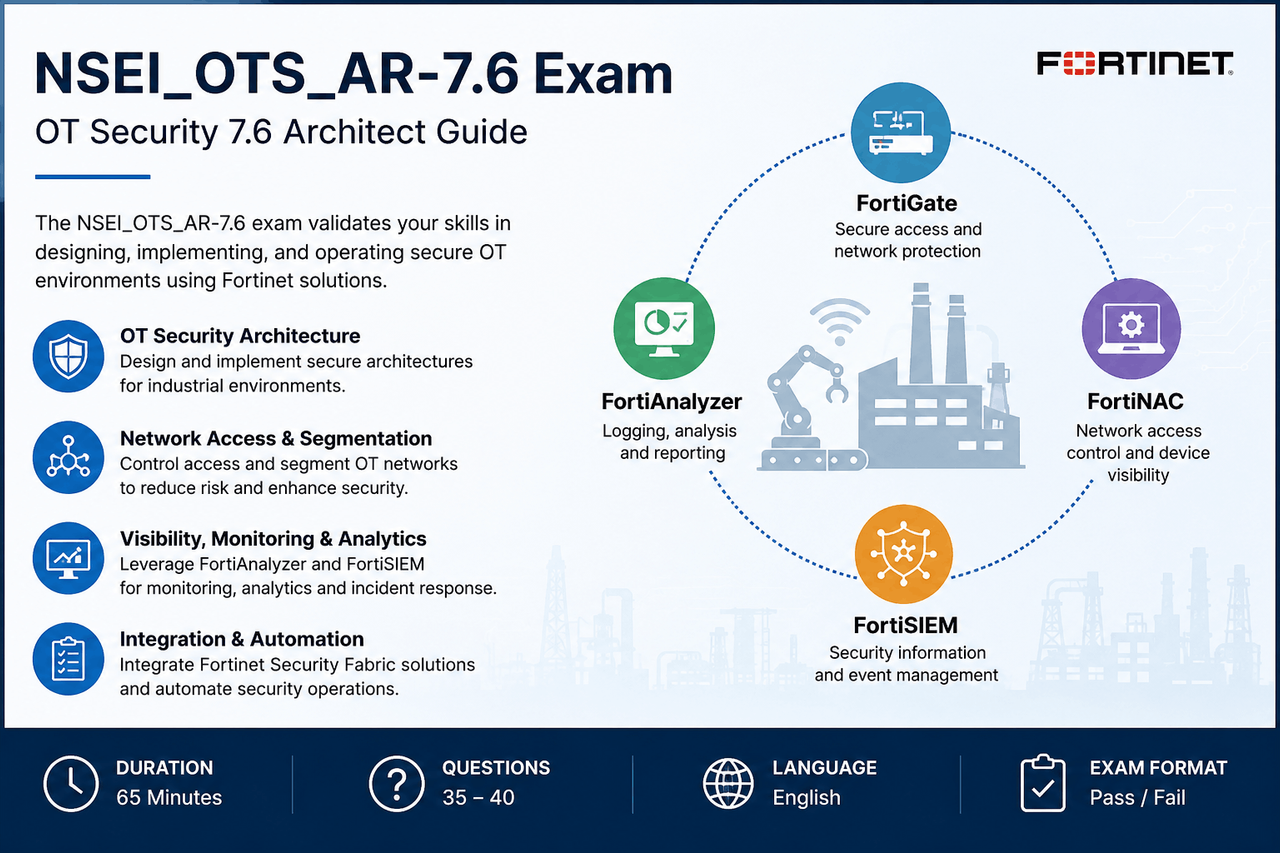
Fortinet describes the certification as the Fortinet NSE I - OT Security 7.6 Architect exam and states that it evaluates applied knowledge of designing, implementing, operating, and integrating an OT security solution using FortiGate, FortiAnalyzer, FortiSIEM, and FortiNAC.
For candidates, this means preparation should go beyond learning individual product features. A strong understanding of OT architecture, network segmentation, asset visibility, access control, industrial protocol security, monitoring, risk assessment, and Fortinet Security Fabric integration is important.
What Is The NSEI_OTS_AR-7.6 Exam?
The NSEI_OTS_AR-7.6 exam is designed for network and security professionals responsible for designing and implementing security for OT infrastructure using Fortinet technologies.
The certification covers several Fortinet products because OT security is rarely handled by a single security control. A typical architecture may require network protection, endpoint and device visibility, centralized analysis, event monitoring, and coordinated security operations.
The current Fortinet exam information identifies FortiOS 7.6, FortiAnalyzer 7.6, FortiSIEM 7.4, and FortiNAC 7.6 as the relevant product versions.
Fortinet recommends at least two years of experience designing, implementing, and integrating Fortinet solutions in an OT infrastructure. Hands-on experience with the exam topics is also strongly encouraged.
NSEI_OTS_AR-7.6 Exam Format
The current published exam details list 35-40 questions and 65 minutes of examination time. The exam is currently available in English and uses a pass-or-fail scoring model.
Because Fortinet's certification program has undergone changes during 2026, candidates should verify the latest exam information before scheduling. Fortinet's release notices show that the OT Security 7.6 Architect exam was released in January 2026 and was subsequently incorporated into the updated certification structure.
What Topics Should Candidates Study?
The published objectives provide a useful framework for preparation. The exam covers four major areas: asset management, network access control, network security, and monitoring and risk assessment.
Asset Management And OT Visibility
Effective OT security begins with understanding the environment being protected.
Candidates should understand OT standards and Fortinet compliance considerations, the role of the Fortinet Security Fabric in an OT network, and device detection using FortiGate and FortiNAC.
Asset visibility is particularly important in industrial environments because unknown or unauthorized devices can introduce security risks. Before applying an appropriate security policy, administrators need reliable information about connected systems and their network behavior.
When preparing for this section, think in terms of a real environment. If an unfamiliar device appears on an industrial network, what information would help identify it? Which Fortinet component could provide visibility? How could that information influence the security policy?
This scenario-based approach is more useful than memorizing terminology alone.
Network Access Control And Segmentation
Network access control is another core part of OT security architecture.
The exam objectives include OT Ethernet concepts, network segmentation schemas, and network access authentication.
Segmentation is especially important in industrial environments because different systems may have different operational requirements and risk levels. Separating network zones can help reduce unnecessary communication and limit the potential impact of a compromised system.
Candidates should understand the purpose of segmentation and how access-control mechanisms support the architecture.
Instead of simply learning configuration commands, consider why a particular system should communicate with another system and what security control should be used when that communication is not required.
Monitoring And Risk Assessment
Deploying security controls is only one part of an OT security strategy. Organizations also need continuous monitoring and risk assessment.
The published objectives include creating FortiAnalyzer event handlers, performing risk assessment and management, and analyzing security reports from FortiAnalyzer.
Candidates should understand how security information can be collected and transformed into useful operational information.
A practical way to study this area is to follow an event from detection through analysis. What information is generated? How is it collected? How can an administrator determine whether the event represents a significant risk? What information can be used to support a response?
This type of reasoning can help with scenario-based examination questions.
Understanding The Fortinet Security Fabric For OT
The Fortinet Security Fabric is an important architectural concept because multiple Fortinet products can contribute to the overall OT security design.
FortiGate can provide network security and inspection capabilities, while FortiNAC can contribute to device visibility and network access control. FortiAnalyzer provides analysis and reporting capabilities, and FortiSIEM can support security information and event management.
The Fortinet OT Security 7.6 training course specifically covers designing, deploying, administering, and monitoring FortiGate, FortiNAC, FortiAnalyzer, and FortiSIEM in OT environments.
For exam preparation, candidates should understand the relationship between these technologies rather than treating them as four unrelated products.
How To Prepare For The NSEI_OTS_AR-7.6 Exam
A structured preparation strategy should begin with the official exam objectives. Use each objective as a checklist and identify areas where additional study or hands-on work is required.
Fortinet recommends the OT Security 7.6 Architect course and hands-on labs, along with relevant FortiGate, FortiAnalyzer, FortiSIEM, and FortiNAC training. The recommended documentation includes the corresponding administration guides and CLI reference material.
Hands-on practice can be particularly valuable for this exam. If you have access to a suitable lab, practice creating segmentation designs, configuring authentication, identifying devices, applying security inspection, reviewing FortiAnalyzer reports, and understanding how the different Fortinet components interact.
The objective should be to understand the reasoning behind each configuration rather than simply reproduce a sequence of steps.
NSEI_OTS_AR-7.6 Exam Questions Resource 1
Practice questions can be useful for checking your understanding and identifying areas that require additional review.
A natural place to add your first resource is here:
NSEI_OTS_AR-7.6 Exam Questions Resource 1: Use this practice resource to review OT security concepts, evaluate your understanding of the exam objectives, and identify topics that need further study.
https://www.dumpslink.com/NSEI_OTS_AR-7.6-pdf-dumps.html
Conclusion
The NSEI_OTS_AR-7.6 exam focuses on the practical design and operation of security architectures for operational technology environments.
The most important preparation areas include asset visibility, OT network segmentation, access authentication, industrial protocol inspection, virtual patching, automation, monitoring, risk assessment, and integration across Fortinet security technologies.
A strong study plan should combine the current Fortinet exam objectives with version-specific documentation, official training, hands-on laboratory practice, and carefully selected practice questions.
Rather than attempting to memorize isolated answers, candidates should develop an architectural understanding of how FortiGate, FortiNAC, FortiAnalyzer, and FortiSIEM can work together to protect an OT environment. That approach is more useful for scenario-based exam preparation and provides knowledge that can also be applied to real-world OT security projects.