AB-731 Exam: Building The Business Mindset For AI Transformation
Artificial intelligence is becoming a strategic business capability rather than a technology limited to specialist teams. Organizations are using generative AI to improve productivity, redesign workflows, support decision-making, enhance customer experiences, and create new ways of working.
This shift has created a different kind of requirement for business professionals. They do not necessarily need to build AI models or write software, but they do need to understand where AI can create value, how to select appropriate AI capabilities, what risks should be considered, and how an organization can introduce AI responsibly.
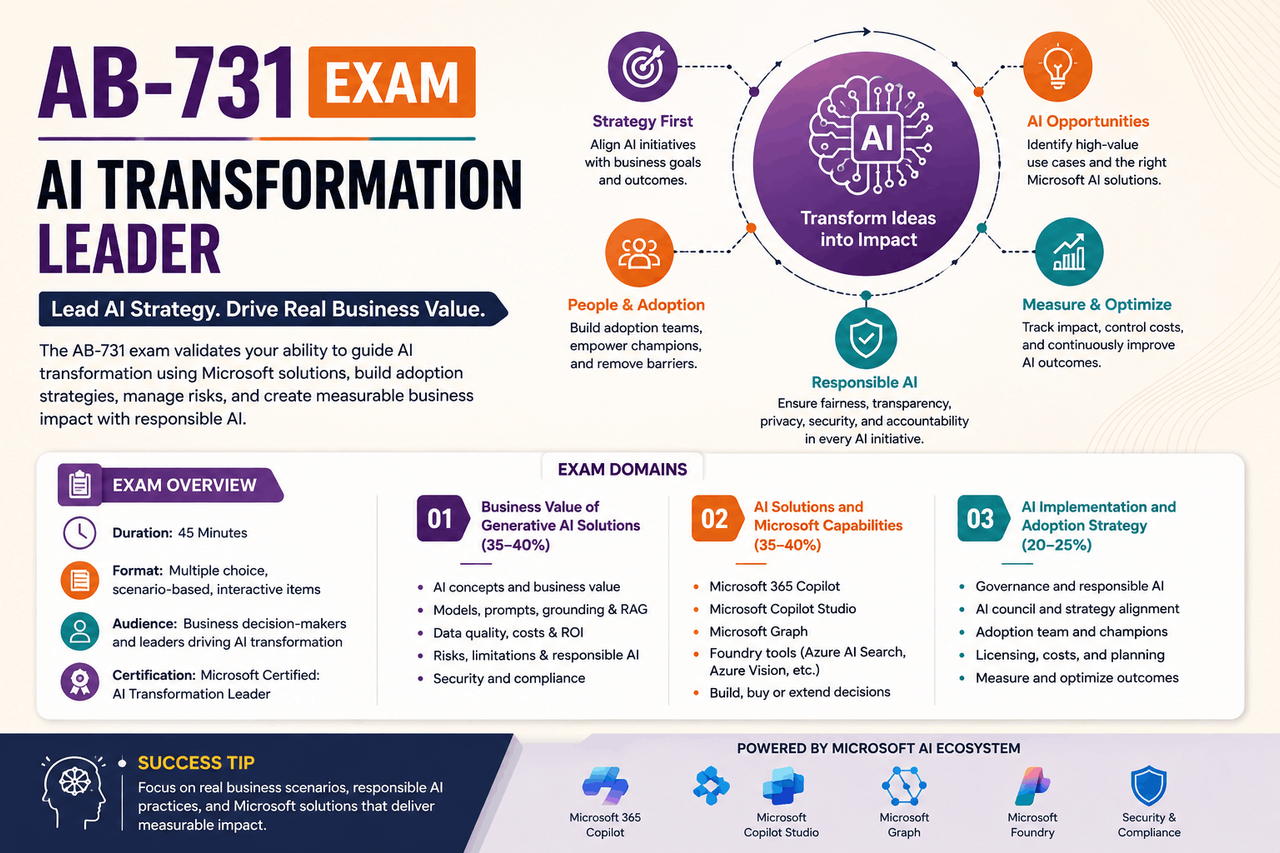
The AB-731 Exam Dumps, associated with the Microsoft Certified: AI Transformation Leader certification, is designed around this business-focused perspective. Microsoft describes the certification as being for business decision-makers who guide AI transformation and innovation using Microsoft 365 Copilot, Microsoft AI capabilities, and Microsoft Foundry, without requiring coding skills.
The current exam objectives emphasize three connected areas: identifying the business value of generative AI solutions, recognizing opportunities and capabilities across Microsoft's AI applications and services, and developing an implementation and adoption strategy.
What Is The AB-731 Exam?
AB-731 is the examination associated with Microsoft's AI Transformation Leader certification.
It is categorized as a beginner-level certification and is aimed at business leaders and decision-makers rather than software developers or AI engineers. Candidates are expected to understand AI concepts, evaluate transformation opportunities, connect AI investments with business goals, and help guide adoption across teams.
Microsoft states that candidates should be familiar with Microsoft 365 services, Microsoft Foundry, and general AI capabilities. Experience with business transformation, adoption, or change management is also relevant to the certification's intended audience.
The current exam provides 45 minutes for completion. Microsoft also states that the exam is proctored and may include interactive components.
This means AB-731 should not be approached as a programming examination. Its emphasis is on understanding AI from the perspective of business value, strategic decisions, responsible adoption, and organizational transformation.
What Skills Does AB-731 Measure?
The current AB-731 exam is divided into three major skill areas:
Identify the business value of generative AI solutions - 35-40%
Identify benefits, capabilities, and opportunities for Microsoft's AI apps and services - 35-40%
Identify an implementation and adoption strategy for Microsoft's AI apps and services - 20-25%
These weightings provide an important clue about preparation. Candidates should not spend all their study time learning individual Microsoft products. The exam is equally concerned with understanding AI business value and developing an effective adoption strategy.
Understanding The Business Value Of Generative AI
The first major domain focuses on why organizations use generative AI and how they can evaluate its potential.
Candidates should understand the basic concepts behind generative AI and recognize situations in which generative AI can provide meaningful business benefits.
A useful starting point is to distinguish between technology capability and business value.
An AI system may be technically impressive, but that does not automatically make it valuable to an organization. A useful business case should connect the technology to a measurable problem or opportunity.
For example, an organization might consider generative AI to reduce repetitive work, improve access to internal knowledge, accelerate content creation, support research, or assist employees with routine tasks.
Responsible AI And Security
Responsible AI is a central concept in AI transformation.
Microsoft's AB-731 objectives include responsible AI principles such as fairness, reliability and safety, privacy and security, inclusiveness, transparency, and accountability.
These principles can influence decisions throughout an AI initiative.
For example, privacy considerations become important when an AI system processes personal information. Transparency may be important when users need to understand how an AI-assisted decision was produced. Accountability helps establish who is responsible for managing and monitoring an AI system.
Security is similarly important because AI applications may interact with organizational information, users, applications, and business processes.
A strong AI transformation strategy therefore considers responsible AI from the beginning rather than treating it as an additional step after implementation.
Microsoft 365 Copilot And Business Productivity
Microsoft 365 Copilot is an important part of the current AB-731 knowledge area.
Candidates should understand how AI capabilities can support work across Microsoft 365 and how organizations can identify suitable use cases.
The business value may involve reducing repetitive tasks, improving access to information, assisting with content creation, supporting analysis, or helping employees work more efficiently.
However, organizations should evaluate AI adoption based on actual workflows rather than simply introducing AI because it is available.
A useful approach is to identify repetitive or time-consuming activities, determine whether AI can assist effectively, assess the risks, and then measure whether the change produces a meaningful improvement.
AI Governance And Leadership
Governance becomes increasingly important as AI systems are introduced across multiple departments.
An AI governance approach can help establish policies, responsibilities, risk-management practices, and decision-making structures.
The AB-731 objectives include planning responsible AI adoption and developing organizational strategies around AI transformation.
Governance does not necessarily mean preventing experimentation. Effective governance can provide boundaries that allow organizations to experiment while maintaining appropriate oversight.
Business leaders should understand who owns AI decisions, how risks are escalated, how approved use cases are identified, and how AI performance is monitored.
Measuring AI Business Impact
An AI initiative should have measurable objectives.
Depending on the use case, organizations might evaluate productivity, processing time, customer satisfaction, employee engagement, quality, cost reduction, or other relevant business indicators.
The exact measurement depends on the problem being addressed.
The key principle is to establish a baseline before implementation and then determine whether the AI solution produces a meaningful improvement.
This also helps leaders make better decisions about whether an AI initiative should be expanded, modified, or discontinued.
Practice Questions As A Knowledge Check
Practice questions can be useful for identifying knowledge gaps and becoming familiar with the style of an assessment.
Microsoft provides practice assessments and an exam sandbox through its certification resources. Microsoft explains that practice assessments can help candidates evaluate readiness and identify areas requiring additional preparation, while the sandbox allows candidates to become familiar with the exam environment.
Practice material should be used to test understanding rather than to memorize question-and-answer combinations.
After answering a question, ask why the selected option is appropriate and why the alternatives are less suitable.
Exam Question Resource 1
https://www.dumps4less.com/AB-731-dumps-pdf.html
This is the recommended location for adding your DumpsLink exam-question resource. Keep the surrounding text informational and avoid claims that the resource contains actual, guaranteed, or leaked examination questions.
Final Thoughts
The AB-731 Exam reflects the growing importance of AI leadership within modern organizations.
Its current objectives cover the business value of generative AI, AI models and prompting, grounding and RAG, data quality, responsible AI, Microsoft's AI applications and services, Microsoft 365 Copilot, Copilot Studio, Microsoft Foundry, implementation planning, governance, and organizational adoption.
The strongest preparation strategy is therefore not based on memorizing isolated AI definitions.
Candidates should learn to connect business problems, AI capabilities, responsible practices, organizational readiness, and measurable outcomes.
For professionals preparing for AB-731, the official Microsoft study guide should remain the primary source for determining the current exam scope. From there, practical scenarios, current Microsoft documentation, and legitimate practice assessments can help build the broader understanding expected from an AI Transformation Leader.