SC-500 Exam Guide: Exam Objectives, Skills, Preparation Plan, And Practice Resources
Cloud security is becoming more complex as organizations combine traditional infrastructure with hybrid environments, modern applications, and AI workloads. Security engineers therefore need to understand more than basic identity or network protection. They must be able to apply security controls across the entire technology environment.
The SC-500 exam is Microsoft's current certification exam for professionals preparing for the Microsoft Certified: Cloud and AI Security Engineer Associate credential. The certification focuses on implementing end-to-end security controls across Azure, hybrid environments, and AI-enabled workloads.
Microsoft currently lists SC-500 as a beta exam. The exam is designed for security engineers who protect organizational systems and data and who work across identity, networking, applications, data, compute, and AI security.
What Is The SC-500 Exam?
SC-500 evaluates whether candidates can implement and manage security controls in cloud and hybrid environments.
Unlike a certification focused on only one security product, the exam covers several interconnected areas. Candidates are expected to understand how security controls can protect identities, resources, data, applications, infrastructure, and AI workloads.
Microsoft's current candidate profile recommends practical experience administering Azure and hybrid environments, including compute, networking, and storage. It also recommends strong familiarity with Microsoft Entra ID and familiarity with Microsoft 365 administration.
The certification is particularly relevant to professionals working as or toward roles such as:
✅ Cloud security engineer
✅ Security engineer
✅ Azure security professional
✅ Cloud infrastructure security specialist
✅ Security operations professional
✅ Identity and access specialist
SC-500 Exam Information
The current Microsoft certification page provides the following key information:
| Item | Current Details |
|---|---|
| Exam | SC-500 |
| Certification | Microsoft Certified: Cloud and AI Security Engineer Associate |
| Status | Beta |
| Level | Intermediate |
| Role | Security Engineer |
| Passing score | 700 |
| Exam duration | 120 minutes |
| Exam language | English |
| Exam delivery | Proctored |
| Main focus | Cloud, hybrid, and AI security |
Microsoft states that beta exams are not scored immediately because data is collected about the quality of the questions and the assessment.
Because the exam is in beta, candidates should be cautious about relying on unofficial claims concerning a fixed number of questions or a permanent question distribution.
SC-500 Exam Objectives
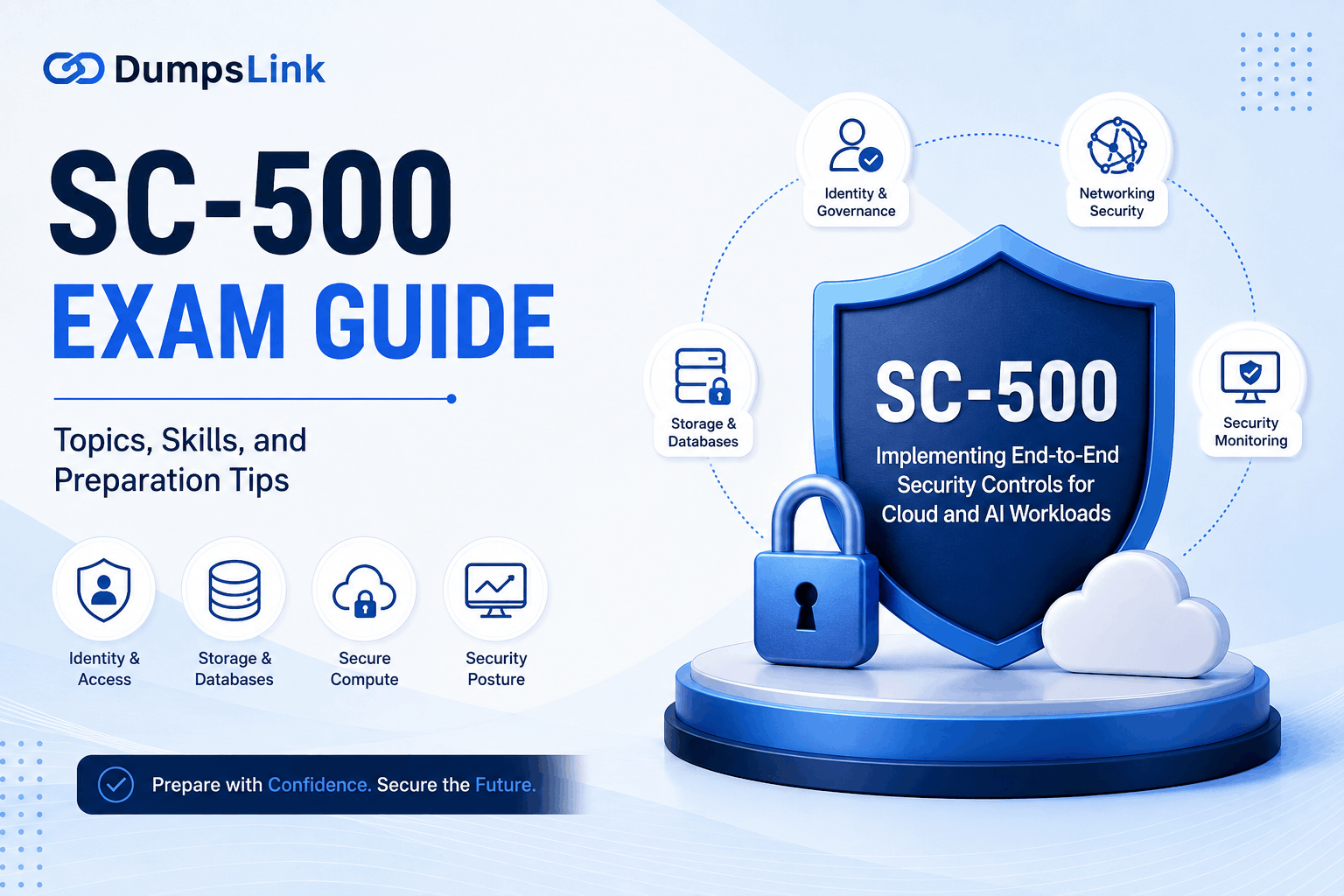
The current SC-500 study guide divides the exam into four major skill areas:
✅ Manage identity, access, and governance - 20-25%
✅ Secure storage, databases, and networking - 25-30%
✅ Secure compute - 20-25%
✅ Manage and monitor security posture - 20-25%
These percentages indicate the relative emphasis of each area in the current skills outline.
Understanding these four domains is one of the best ways to organize your preparation.
Manage Identity, Access, And Governance
Identity is one of the first security boundaries in a cloud environment. SC-500 therefore places significant attention on controlling access to resources and protecting credentials, secrets, and keys.
Candidates should be familiar with concepts involving Microsoft Entra ID, including:
✅ Conditional Access
✅ Multifactor authentication
✅ Passwordless authentication
✅ Privileged Identity Management
✅ Enterprise applications
✅ App registrations
✅ OAuth permissions
✅ Consent settings
✅ Managed identities
The objective also includes protecting secrets and cryptographic material with Azure Key Vault.
Preparation should include understanding how Key Vault is deployed, how access is configured, and how keys, secrets, and certificates are managed.
Why Identity Matters
A cloud security engineer may need to answer questions such as:
✅ How can access to a sensitive resource be restricted?
✅ Which identity should an application use?
✅ How can privileged permissions be controlled?
✅ How can authentication requirements be enforced?
✅ How should application secrets be protected?
Understanding the security principle behind each control is more useful than simply memorizing product names.
Secure Storage, Databases, And Networking
The second major domain covers protection of data and network resources.
Candidates should develop knowledge of security controls for:
✅ Azure Storage
✅ Azure databases
✅ Virtual networks
✅ Private endpoints
✅ Network security
✅ Azure Firewall
✅ Web Application Firewall
✅ Application Gateway
✅ Azure Front Door
✅ DDoS protection
Network monitoring and diagnostics
The current Microsoft study guide specifically references technologies and documentation covering Azure Firewall, Application Gateway, Azure Front Door, Web Application Firewall, Private Link, DDoS Protection, storage, and Azure SQL.
Think In Terms Of Security Requirements
Rather than memorizing every feature of every networking service, consider the requirement first.
For example:
Requirement: A private application should communicate with a database without exposing the database through a public endpoint.
The candidate needs to understand which networking and access mechanisms can satisfy that requirement.
This scenario-based approach is particularly useful when preparing for cloud security assessments.
Secure Compute
Compute resources can introduce significant security risks when they are incorrectly configured, left unpatched, or exposed to unnecessary access.
SC-500 preparation should include security concepts involving:
✅ Azure virtual machines
✅ Servers
✅ Hybrid environments
✅ Multicloud resources
✅ Vulnerability management
✅ Defender for Cloud
✅ Workload protection
✅ External attack surface management
Microsoft's current study guide includes connecting hybrid and multicloud environments to Defender for Cloud, configuring workload protection, using vulnerability management capabilities for Azure VMs, and discovering exposed or vulnerable assets.
Candidates should understand not only how compute resources are deployed but also how their security posture can be assessed and monitored after deployment.
Secure AI Workloads
One of the most important differences in the current SC-500 objectives is the explicit focus on AI security.
Microsoft's study guide includes multiple AI-related responsibilities, including:
✅ Identifying overexposure of data in SharePoint
✅ Assessing risks involving Microsoft Copilot and AI applications
✅ Microsoft Purview Data Security Posture Management
✅ Microsoft Copilot Studio agent protection
✅ Microsoft Entra Agent ID
✅ AI Gateway in Azure API Management
✅ Microsoft Foundry security
✅ Defender for AI Service
✅ AI security guardrails
✅ AI security monitoring
This means candidates should not treat AI security as a separate topic unrelated to traditional cloud security. Identity, data protection, permissions, monitoring, and workload security all remain important when AI services are introduced.
Manage And Monitor Security Posture
Security controls need continuous monitoring. A correctly configured resource can become a risk later because of configuration changes, newly discovered vulnerabilities, excessive permissions, or emerging threats.
The SC-500 objectives therefore include security posture management and monitoring.
Candidates should understand technologies and concepts related to:
✅ Microsoft Defender for Cloud
✅ Microsoft Sentinel
✅ Microsoft Defender XDR
✅ Security monitoring
✅ Security recommendations
✅ Security alerts
✅ Log collection
✅ Automation
✅ Incident investigation
✅ Security posture assessment
The current study guide includes Microsoft Sentinel activities such as workspace configuration, data connectors, event collection, custom log tables, automation rules, playbooks, and data retention.
Microsoft Security Technologies To Study
A broad understanding of Microsoft's security ecosystem is useful when preparing for SC-500.
Some of the technologies appearing in the current objectives include:
Microsoft Entra ID
Used for identity and access management. Important preparation areas include authentication, Conditional Access, privileged access, application identities, and managed identities.
Azure Key Vault
Used to protect keys, secrets, and certificates. Candidates should understand deployment, access control, and security configuration.
Microsoft Defender For Cloud
Provides cloud security posture management and workload protection capabilities across supported environments.
Microsoft Sentinel
A cloud-native security information and event management platform used for collecting, analyzing, and responding to security data.
Microsoft Defender XDR
Provides security capabilities across multiple Microsoft services and helps security teams investigate and respond to threats.
Microsoft Purview
Provides capabilities related to data governance, compliance, information protection, and security-related data controls.
Microsoft Security Copilot
The current SC-500 objectives include configuration and management concepts related to Security Copilot.
Microsoft Foundry And AI Security
AI security is an important part of the current exam objectives, including security controls, monitoring, identity, and protection for AI workloads.
How To Create An SC-500 Study Plan
A good study plan should follow the exam objectives instead of treating every technology as equally important.
Week 1: Identity And Access
Start with:
✅ Microsoft Entra ID
✅ Conditional Access
✅ MFA
✅ Passwordless authentication
✅ Privileged Identity Management
✅ Managed identities
✅ Enterprise applications
✅ App registrations
✅ OAuth permissions
✅ Azure Key Vault
Focus on understanding the security problem each feature solves.
Week 2: Network, Storage, And Data Security
Study:
✅ Azure networking
✅ Network security
✅ Private endpoints
✅ Azure Firewall
✅ Web Application Firewall
✅ Application Gateway
✅ Front Door
✅ DDoS Protection
✅ Storage security
✅ Database security
Use practical scenarios to connect the services with specific security requirements.
Week 3: Compute And AI Security
Move to:
✅ Azure VMs
✅ Defender for Cloud
✅ Vulnerability management
✅ Hybrid and multicloud security
✅ AI workload protection
✅ Microsoft Foundry security
✅ Microsoft Entra Agent ID
✅ Microsoft Copilot security
✅ AI security monitoring
The AI portion deserves particular attention because it is a significant part of the newer Cloud and AI Security Engineer role.
Week 4: Monitoring And Review
Use the final stage to review:
✅ Microsoft Sentinel
✅ Defender XDR
✅ Security posture
✅ Monitoring
✅ Security recommendations
✅ Automation
✅ Incident investigation
✅ Weak areas from practice questions
If certain concepts remain difficult, return to the relevant Microsoft documentation instead of repeatedly memorizing practice-question answers.
Should You Use SC-500 Practice Questions?
Practice questions can be useful when they are used correctly.
They can help candidates:
✅ Become familiar with scenario-based questions
✅ Identify weak knowledge areas
✅ Practice eliminating incorrect answers
✅ Review unfamiliar technologies
✅ Improve time management
However, practice material should be treated as a learning aid rather than a replacement for the official exam objectives.
For an additional question-based resource, a natural placement in the article is:
SC-500 Exam Questions Resource: https://www.dumpslink.com/SC-500-pdf-dumps.html
Candidates should verify that any third-party resource is being used for legitimate preparation and should never rely on claims that a question bank contains confidential or guaranteed exam content.
How To Approach SC-500 Scenario Questions
When a question presents a complicated cloud security scenario, avoid immediately searching your memory for a product name.
Instead, break the problem into four steps.
Step 1: Identify The Asset
Determine what needs protection.
Is the scenario about:
✅ An identity?
✅ A secret?
✅ A virtual machine?
✅ A database?
✅ Network traffic?
✅ Sensitive data?
✅ An AI application?
Step 2: Identify The Risk
Determine what could go wrong.
Examples include:
✅ Unauthorized access
✅ Excessive permissions
✅ Data exposure
✅ Network exposure
✅ Vulnerability
✅ Poor monitoring
✅ Inadequate workload protection
Step 3: Identify The Security Requirement
Ask what the organization actually needs to accomplish.
For example, does it need stronger authentication, restricted network access, vulnerability detection, centralized monitoring, or protection against data exposure?
Step 4: Select The Most Appropriate Control
Only after identifying the requirement should you select the Microsoft service or security feature.
This approach helps prevent a common preparation problem: recognizing a familiar product but choosing it for the wrong purpose.
Is Hands-On Experience Important For SC-500?
Yes. Microsoft explicitly recommends training and hands-on experience before taking the exam. The SC-500 study guide is built around practical security responsibilities across Azure and hybrid environments.
Hands-on practice can help candidates understand how security settings behave in real environments.
For example, instead of simply reading about Conditional Access, a candidate can study how policies affect authentication requirements.
Similarly, learning about Defender for Cloud is more useful when the candidate understands how security recommendations and workload protection relate to actual resources.
What About The SC-500 Exam Sandbox?
Microsoft provides an exam sandbox that allows candidates to experience the look and feel of the exam interface and interact with different question types.
Using the sandbox before the actual assessment can help reduce uncertainty about the exam environment.
It is especially useful for candidates who have not previously taken a Microsoft certification exam with interactive components.
SC-500 Vs. Traditional Azure Security Preparation
SC-500 represents a broader direction for the security engineer role.
Microsoft's previous Azure Security Engineer Associate certification is scheduled to retire on August 31, 2026, while SC-500 expands the security-engineering scope to include cloud and AI security.
This change is significant because modern security teams increasingly need to secure AI-enabled applications alongside traditional cloud infrastructure.
As a result, candidates preparing for SC-500 should avoid studying only traditional Azure infrastructure security. Identity, data protection, AI workloads, security posture, and monitoring are also part of the current scope.
Common Questions About SC-500
What Is The Passing Score For SC-500?
Microsoft currently lists 700 as the passing score.
How Long Is The SC-500 Exam?
Microsoft currently provides 120 minutes to complete the assessment.
Is SC-500 Currently A Beta Exam?
Yes. Microsoft currently identifies SC-500 as a beta exam. Beta exams are used to collect data about the assessment and its questions.
What Topics Are Covered By SC-500?
The current objectives cover identity, access and governance; storage, databases and networking; compute; and security posture management and monitoring. AI security is also incorporated into the current skills measured.
Is Hands-On Azure Experience Recommended?
Yes. Microsoft recommends practical experience with Azure and hybrid environments, including compute, networking, and storage. Strong familiarity with Microsoft Entra ID is also recommended.
Is A Practice Assessment Currently Available?
Microsoft's current certification page states that the practice assessment for SC-500 is not currently available while the exam is in beta.
Conclusion
The SC-500 exam reflects the changing responsibilities of modern cloud security engineers. Its current objectives go beyond traditional Azure infrastructure protection by combining identity, networking, storage, compute, monitoring, and AI security.
Candidates who approach the exam as a collection of memorization topics may struggle with unfamiliar scenarios. A better strategy is to understand the security requirement behind each technology and learn how Microsoft's security services can address that requirement.
Start with the official SC-500 study guide, build practical knowledge around the measured skills, and use practice questions to identify gaps rather than simply memorizing answers. Since the exam is currently in beta, candidates should also check Microsoft's official certification page for the latest changes before taking the assessment.
The goal should not simply be to recognize the correct answer on an exam. It should be to develop the security knowledge needed to protect real cloud, hybrid, and AI environments.